1. Overview¶
What the Link Identity Platform is, what it does and does not do, and the capabilities every Link product builds on.
1.1 What It Is¶
Link Identity Platform is a general-purpose biometric identity service that provides a fully configurable identity stack to all tenants. Every tenant can enable the capabilities they need: user management, authentication, KYC verification, palm biometrics, sessions, and compliance.
1.2 Core Function¶
User Management: signup (OTP, email/password, Google, Apple) → user_id created
KYC [POST-MVP]: user_id + provider (Nafath, Onfido, etc.) → verified identity
Enrollment: user_id + palm_template → stored mapping
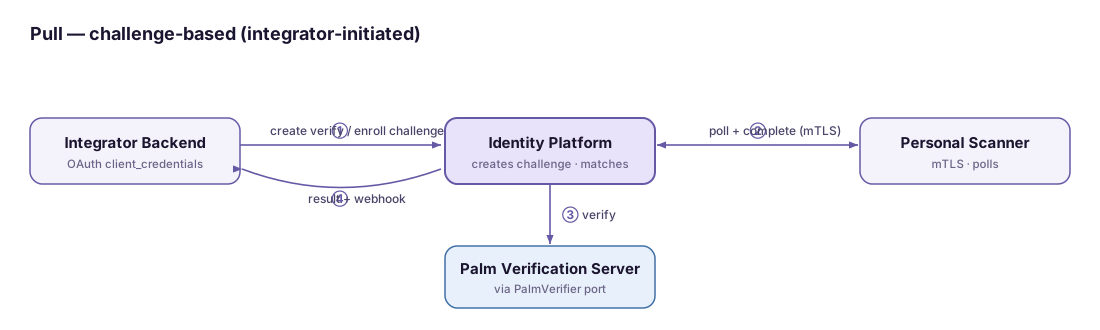
Verification: user_id + palm_scan → match result + metadata (1:1)
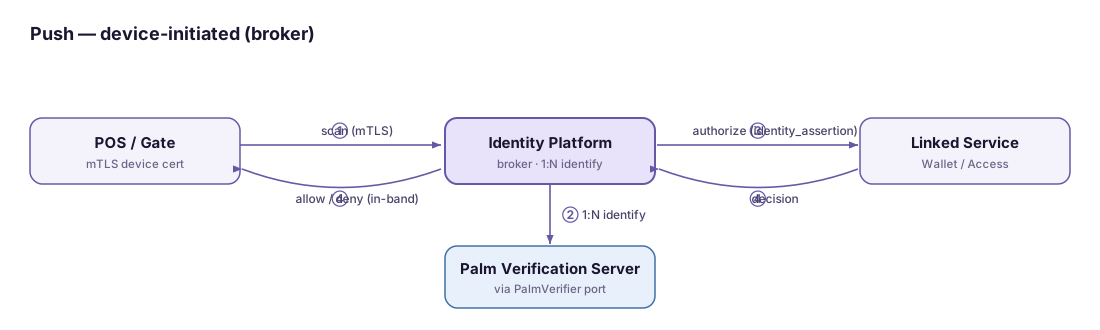
Identification: palm_scan → user_id (1:N search)
Diagram 1.1 — System Architecture Overview
flowchart TB
subgraph Clients
MA[Mobile App]
end
subgraph Identity-Managed Devices
PS[Personal Scanner]
POS[POS / Kiosk]
AS[Access Gate]
end
subgraph Link Verticals
ENV[Envoy Gateway]
WB[Wallet Backend]
AB[Access Backend]
end
subgraph Integrators
IG[InvestGlass]
PB[PartnerBank]
HA[HealthApp]
end
subgraph Link Identity Platform
WC[Web Console]
API[Identity API<br/>FastAPI]
DB[(PostgreSQL)]
RD[(Redis)]
end
subgraph External Providers
subgraph KYC Providers
NAF[Nafath]
ONF[Onfido]
end
subgraph Palm Vendors
LN[X-Telcom BioWave Pass]
end
subgraph Social Auth
GOO[Google]
APL[Apple]
end
SMS[SMS Gateway]
EMAIL[Email Service]
end
%% Device connections (all mTLS to Identity)
MA -->|JWT via JWKS| ENV
PS -->|mTLS| API
POS -->|mTLS| API
AS -->|mTLS| API
%% Vertical connections
ENV -->|X-User-ID| WB
ENV -->|X-User-ID| AB
WB -->|Client Credentials| API
AB -->|Client Credentials| API
API -->|authorize §10| WB
API -->|authorize §10| AB
%% Integrator connections
IG -->|Client Credentials| API
PB -->|Client Credentials| API
HA -->|Client Credentials| API
%% Identity Platform internal
WC --> API
API --> DB
API --> RD
%% External provider connections
API -->|KYC Port| NAF
API -->|KYC Port| ONF
API -->|Palm Port| LN
API --> GOO
API --> APL
API --> SMS
API --> EMAIL
1.3 What Link Provides¶
All capabilities available to all tenants (configurable per tenant): - User creation and management (platform-created or integrator-provided user_id) - Multiple auth methods (OTP, email/password, Google, Apple) - Session tokens with refresh (JWT) - KYC verification (pluggable providers: Nafath, Onfido, etc.) — [POST-MVP], §7 - Palm enrollment, verification (1:1), and identification (1:N) - Verification and identification metadata (confidence, timestamp) - Account linking (across auth methods) - Multi-tenant isolation - Consent management and compliance (DSR, enhanced audit) - Device fleet management — pairing, mTLS, revocation for pos/gate/kiosk/personal-scanner (§9) - Device-initiated palm transactions — synchronous broker to product backends (§10)
Each capability is configurable per tenant. Tenants enable only what they need.
1.4 What Link Does NOT Do¶
Identity identifies and routes; it does not decide product business outcomes, and it is not a full OIDC provider.
| Item | Reason |
|---|---|
| Full OIDC provider (authorization endpoint) | Post-MVP. May be added when third-party "Login with Link" is needed. |
| SSO / SAML | Post-MVP. Not needed for the current B2B2C model. |
| Product business logic (charge wallet, grant access) | The product's domain — Identity identifies the user and routes the decision via the broker (§10); it does not charge or grant access. |
1.5 Core Capabilities¶
All capabilities are available to all tenants, configured individually per tenant (see §4.5 for the settings, §4.6 for examples).
| Capability | Default | Configurable Via |
|---|---|---|
| User registration | Available | Per-request on POST /v1/users |
| Auth methods | All enabled | auth_methods |
| Session tokens | Enabled with auth | Enabled when auth is configured |
| Account linking | Always enabled | — |
| KYC verification | Not required | kyc_required (KYC integration is [POST-MVP] — §7) |
| Palm enrollment | Available | Always available |
| Verification (1:1) | Available | Always available |
| Identification (1:N) | Available | Always available |